Buy loir-et-berce.eu ?
We are moving the project
loir-et-berce.eu .
Are you interested in purchasing the domain
loir-et-berce.eu ?
domain@kv-gmbh.de · 0541-91531010
Buy loir-et-berce.eu ?
Can matrices be divided?
Matrices cannot be divided in the same way that numbers can be divided. However, matrices can be multiplied by the inverse of another matrix, which is similar to division. This operation is used to solve systems of linear equations and find solutions to matrix equations. Overall, while matrices cannot be divided in the traditional sense, there are operations that can achieve similar results. **
What are representation matrices?
Representation matrices are matrices that represent linear transformations or operators. They are used to represent the action of a linear transformation on a vector space. The elements of the representation matrix correspond to the coefficients of the linear combination of the basis vectors of the vector space. By using representation matrices, we can easily perform operations such as composition of linear transformations and finding the inverse of a linear transformation. **

Similar search terms for Matrices
Top-Angebote
Products related to Matrices:




-
Which matrices are commutative?
Two matrices are commutative if their product is the same regardless of the order in which they are multiplied. In other words, for matrices A and B, if A*B = B*A, then they are commutative. However, not all matrices are commutative. In general, matrices are commutative only if they are scalar multiples of the identity matrix, or if they are diagonal matrices with distinct diagonal entries. **
-
Which matrices contain symbols?
Matrices that contain symbols are typically referred to as symbolic matrices. These matrices can contain variables, parameters, or other mathematical symbols instead of specific numerical values. Symbolic matrices are commonly used in various fields of mathematics, such as linear algebra, calculus, and differential equations, where the exact values of the elements are not known or need to be represented in a general form. These matrices are useful for performing algebraic manipulations, solving equations, and representing mathematical relationships in a more general and abstract manner. **
-
What are stochastic matrices?
Stochastic matrices are square matrices in which each element represents the probability of transitioning from one state to another in a stochastic process. The elements of a stochastic matrix are non-negative and each row of the matrix sums to 1, representing the probabilities of transitioning to all possible states from a given state. Stochastic matrices are commonly used in the study of Markov chains, where they describe the probabilities of transitioning between different states over time. These matrices are important in modeling various real-world phenomena such as population dynamics, financial markets, and biological systems. **
-
What are invertible matrices?
Invertible matrices are square matrices that have an inverse, meaning that there exists another matrix that, when multiplied with the original matrix, results in the identity matrix. The inverse of a matrix A is denoted as A^-1, and it satisfies the property that A * A^-1 = A^-1 * A = I, where I is the identity matrix. Invertible matrices are also called nonsingular matrices, and they are important in various areas of mathematics and applications, such as solving systems of linear equations and in transformations in linear algebra. **


Can someone help with matrices?
Yes, someone can help with matrices. Matrices are a fundamental concept in mathematics and are used in various fields such as physics, computer science, and engineering. There are many resources available online, including tutorials, videos, and forums, where individuals can seek help with understanding and working with matrices. Additionally, seeking help from a teacher, tutor, or classmate can also be beneficial in gaining a better understanding of matrices. **
How do you calculate matrices?
To calculate matrices, you need to perform operations such as addition, subtraction, multiplication, and division on the elements of the matrices. When adding or subtracting matrices, you simply add or subtract corresponding elements. For matrix multiplication, you multiply the rows of the first matrix by the columns of the second matrix and sum the products. To find the inverse of a matrix, you can use various methods such as Gaussian elimination or the adjugate matrix method. **
Top-Angebote
Products related to Matrices:
-
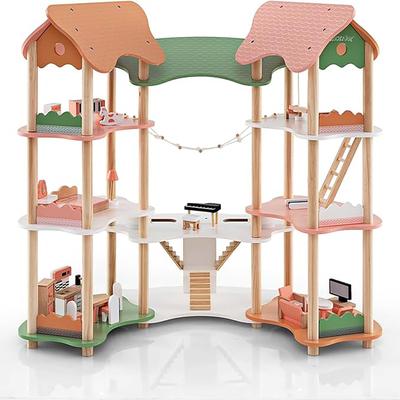
Kids Wooden Dollhouse Aged 3-8 w/ 32PCS Furniture AccessoriesGift your kids an enchanting world with our doll house! Featuring 3 tiers and 7 rooms, our doll house playset turns any nook of your child's room into a whimsical haven of delight.162,99 $*Shipping: 0,00 $Secure redirect to the provider
-
Epson EcoTank ET-2912Save up to 95% on the cost of ink* with an EcoTank ink tank printerSave up to 95% on printing costs* with Epson’s cartridge-free EcoTank printers. With up to 3 years of ink included*, the integrated ink tanks are easy to fill thanks to the specially engineered ink bottles. With an ultra-compact design and flexible, reliable connectivity features, this is the perfect printer for anyone looking for consistent high-quality prints at an incredibly low cost-per-page.Say goodbye to cartridgesEcoTank provides hassle-free home printing - the ultra-high capacity ink tanks allow mess-free refills and the key-lock bottles are designed so only the correct colour can be inserted. The front ink level display means it's easy to see when it’s finally due for a refill.Keep on savingThis economical printer saves you up to 95% on printing costs* and comes with up to 3 years' worth of ink*. One set of ink bottles delivers up to 4,700 pages in black and white and 7,500 in colour*, the equivalent of up to 63 cartridges worth of ink!*Small yet packed with featuresFeaturing a 100-sheet rear paper tray, borderless photo printing (up to 10x15cm) and fast print speeds of up to 11 pages per minute*, you can speed through a variety of tasks with ease. Additional benefits include Apple AirPrint compatibility and an intelligent print quality adjustment function that helps deliver consistent, high‐quality results.Built to lastHeat-Free Printing Technology means the printhead will last the lifetime of the printer* so you can benefit from no unnecessary replacement parts, as well as reduced power consumption compared to laser printers*. Engineered to prevent nozzle clogging, this highly durable printer comes with a 50,000 page (or 1 year) standard warranty*.Modern flexibilityFeaturing an ultra-compact design and Wi-Fi and Wi-Fi Direct connectivity, you can easily integrate this mutlifunction printer with your existing home set-up and print from mobiles, tablets and laptops*. With enhanced support for mesh Wi-Fi networks, the printer's Wi‐Fi is optimised to deliver a reliable and stable connection for a stress-free printing experience.Epson Smart Panel appThis app enables you to control your printer from your smart device*. You can print, copy and scan documents and photos, set up, monitor and troubleshoot your printer, all from your phone or tablet.228,49 £*Shipping: 0,00 £Secure redirect to the provider
-
Can matrices be divided?
Matrices cannot be divided in the same way that numbers can be divided. However, matrices can be multiplied by the inverse of another matrix, which is similar to division. This operation is used to solve systems of linear equations and find solutions to matrix equations. Overall, while matrices cannot be divided in the traditional sense, there are operations that can achieve similar results. **
-
What are representation matrices?
Representation matrices are matrices that represent linear transformations or operators. They are used to represent the action of a linear transformation on a vector space. The elements of the representation matrix correspond to the coefficients of the linear combination of the basis vectors of the vector space. By using representation matrices, we can easily perform operations such as composition of linear transformations and finding the inverse of a linear transformation. **
-
Which matrices are commutative?
Two matrices are commutative if their product is the same regardless of the order in which they are multiplied. In other words, for matrices A and B, if A*B = B*A, then they are commutative. However, not all matrices are commutative. In general, matrices are commutative only if they are scalar multiples of the identity matrix, or if they are diagonal matrices with distinct diagonal entries. **
-
Which matrices contain symbols?
Matrices that contain symbols are typically referred to as symbolic matrices. These matrices can contain variables, parameters, or other mathematical symbols instead of specific numerical values. Symbolic matrices are commonly used in various fields of mathematics, such as linear algebra, calculus, and differential equations, where the exact values of the elements are not known or need to be represented in a general form. These matrices are useful for performing algebraic manipulations, solving equations, and representing mathematical relationships in a more general and abstract manner. **
Similar search terms for Matrices
-
What are stochastic matrices?
Stochastic matrices are square matrices in which each element represents the probability of transitioning from one state to another in a stochastic process. The elements of a stochastic matrix are non-negative and each row of the matrix sums to 1, representing the probabilities of transitioning to all possible states from a given state. Stochastic matrices are commonly used in the study of Markov chains, where they describe the probabilities of transitioning between different states over time. These matrices are important in modeling various real-world phenomena such as population dynamics, financial markets, and biological systems. **
-
What are invertible matrices?
Invertible matrices are square matrices that have an inverse, meaning that there exists another matrix that, when multiplied with the original matrix, results in the identity matrix. The inverse of a matrix A is denoted as A^-1, and it satisfies the property that A * A^-1 = A^-1 * A = I, where I is the identity matrix. Invertible matrices are also called nonsingular matrices, and they are important in various areas of mathematics and applications, such as solving systems of linear equations and in transformations in linear algebra. **
-
Can someone help with matrices?
Yes, someone can help with matrices. Matrices are a fundamental concept in mathematics and are used in various fields such as physics, computer science, and engineering. There are many resources available online, including tutorials, videos, and forums, where individuals can seek help with understanding and working with matrices. Additionally, seeking help from a teacher, tutor, or classmate can also be beneficial in gaining a better understanding of matrices. **
-
How do you calculate matrices?
To calculate matrices, you need to perform operations such as addition, subtraction, multiplication, and division on the elements of the matrices. When adding or subtracting matrices, you simply add or subtract corresponding elements. For matrix multiplication, you multiply the rows of the first matrix by the columns of the second matrix and sum the products. To find the inverse of a matrix, you can use various methods such as Gaussian elimination or the adjugate matrix method. **
* All prices are inclusive of VAT and, if applicable, plus shipping costs. The offer information is based on the details provided by the respective shop and is updated through automated processes. Real-time updates do not occur, so deviations can occur in individual cases. ** Note: Parts of this content were created by AI.